
Carbon Reporting in Construction: How Mutu Calculates Emissions
February 11, 2026

Construction and demolition activities account for around 40% of global energy-related carbon emissions. Embodied carbon reporting in construction measures the emissions associated with producing and transporting materials. Construction emissions tracking software helps organisations track these emissions, reduce waste, and improve sustainability outcomes across projects.
Mutu enables teams to measure embodied carbon through material reuse, giving clear visibility over emissions avoided and supporting more accurate construction sustainability reporting.
Through their proactive approach to reusing surplus materials, emissions can be measured in different ways. This article explains:
- What emissions Mutu reports
- Which emission factors we use
- How we avoid double-counting
- Why we use a single C&D landfill factor
- How users can override Mutu’s default values
What is embodied carbon reporting in construction?
When materials are repurposed through Mutu, two separate emissions benefits can occur.
1. Avoided embodied emissions
This represents the emissions that would have occurred if a new material had to be manufactured and procured.
This approach makes embodied carbon reporting in construction more practical by turning material reuse into measurable emissions data.
Example: If plywood is reused, a new sheet does not need to be produced, transported, and supplied.
This aligns with:
- Scope 3, Category 1 (Purchased goods and services) under the GHG Protocol
- ISO 14064-1 indirect emissions accounting
For construction materials, avoided embodied emissions are typically the largest climate benefit, and this is the primary emissions metric Mutu reports through its construction carbon reporting software.
2. Avoided landfill emissions
This represents the emissions that would have occurred if the material had been disposed of.
These insights help support construction sustainability reporting by showing the emissions avoided when materials are reused instead of sent to landfill.
Example: If plywood is reused instead of landfilled, methane emissions from decomposition are avoided.
This aligns with:
- Scope 3, Category 5 (Waste generated in operations) under the GHG Protocol
- National waste-to-landfill methodologies
Are these impacts “double counted”?
Avoided embodied emissions and avoided landfill emissions:
- Represent different emission sources
- Sit in different Scope 3 categories
- Are based on different baseline scenarios
However, because they come from the same reuse event, they are not and cannot be added together.
How Mutu handles this
- Mutu does not combine embodied emissions avoided and landfill emissions avoided into a single total
- Each metric is reported separately and transparently in our dashboard
This approach aligns with best practice under the GHG Protocol and avoids misleading claims.
How construction emissions are calculated in Mutu
To keep Mutu easy to use, we use simple, conservative default emission factors derived from the leading carbon emission sources in each country. These are starting values only and can be easily overridden by users on the Mutu platform at any time.
Units in Mutu are user-defined and typically include a corresponding weight; emission factors are applied using this weight where available.
Embodied carbon emissions avoided
Mutu applies region-appropriate generic embodied carbon factors based on the most commonly recognised datasets. For:
These factors represent avoided manufacturing emissions (A1 – A3) and are assigned to listings based on one of the five Material classes that are selected by the user in Mutu. You can refer to Appendix A and B for detailed information on emission factor sources.
New Zealand – embodied emission defaults
| Material class | Final value | |
| Value | Unit | |
| Plastic | 0.65 | kg CO2-e / unit |
| Wood | 0.23 | kg CO2-e / unit |
| Metal | 3.95 | kg CO2-e / unit |
| Concrete | 0.15 | kg CO2-e / unit |
| Other | 2.94 | kg CO2-e / unit |
Australia – embodied emission defaults
| Material class | Final value | |
| Value | Unit | |
| Plastic | 0.44 | kg CO2-e / unit |
| Wood | 0.37 | kg CO2-e / unit |
| Metal | 3.48 | kg CO2-e / unit |
| Concrete | 0.15 | kg CO2-e / unit |
| Other | 2.94 | kg CO2-e / unit |
Carbon emissions redirected from landfill
For simplicity and consistency, Mutu applies one default landfill emissions factor for construction and demolition waste per country. As a result:
NZ = 0.16 kg CO₂-e per kg of material
AU = 0.13 kg CO₂-e per kg of material
Refer to Appendix C and D for more detailed information about where these emission factors are derived from.
User control: overriding Mutu’s default factors
All emission factors in Mutu are optional defaults for our 5 general material classes. For any individual material listing, users can:
- Override emission factors directly on the listing, or
- Set organisation specific values for each listing in their Mutu Material Library.
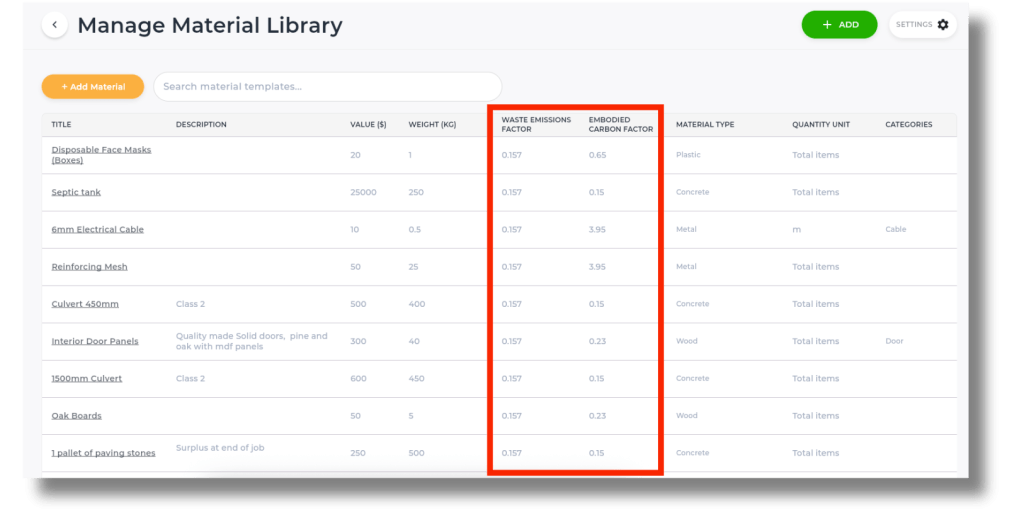
When a user supplies their own factor, Mutu always uses that value instead of the default. If emission factors are known for a specific material listing (typically via an Environmental Product Declaration or EPD), Mutu highly recommends using known values wherever possible to improve construction emissions tracking across projects.
Frequently Asked Questions
What is embodied carbon in construction?
Embodied carbon refers to the emissions generated during the manufacturing, transport, and installation of construction materials. It is a key component of total project emissions and a major focus of sustainability reporting.
How does construction emissions tracking software work?
Construction emissions tracking software measures emissions by tracking material usage, applying emission factors, and calculating total carbon impact across projects. It provides visibility over emissions and supports sustainability reporting.
Why is material reuse important for reducing emissions?
Reusing materials avoids the need for new manufacturing and reduces landfill waste, resulting in lower overall emissions. This makes material reuse one of the most effective ways to reduce embodied carbon in construction.
Can users customise emission factors in Mutu?
Yes, users can override default emission factors with project-specific values. This allows for more accurate emissions tracking based on real material data.
Summary
- Reusing construction materials creates two distinct emissions benefits
- Mutu reports these separately to avoid double counting
- Embodied emissions avoided are the primary metric
- Landfill emissions avoided use a consistent C&D factor
- Factors differ by region and are fully transparent
- Users can override default values at any time
If you have questions about how emissions are calculated for a specific material or project, Mutu’s support team is happy to help.
Appendix
Appendix A – NZ Default Embodied Carbon Factors
All values represent GWP A1–A3 excluding biogenic carbon and are defaults that users can override in your Mutu Material Library for any new material that is added.
Data alignment is with BRANZ NECO2 National embodied carbon platform and average values are applied as a conservative default per material class.
Appendix B – AU Default Embodied-Carbon Factors
All values represent cradle-to-gate (A1-A3) Emission Factors (EF) for building materials and are defaults that users can override in your Mutu Material Library for any new material that is added.
Data alignment is with the NABERS National material emission factors database and average values are applied as a conservative default per material class.
| Material class | Final value | Assumptions | Source | Link | |
| Value | Unit | ||||
| Plastic | 0.44 | kg CO2-e / unit | Plastic sheeting, Min EF | NABERS | https://www.nabers.gov.au/publications/national-emission-factors-database |
| Wood | 0.37 | kg CO2-e / unit | Softwood, Average EF | NABERS | https://www.nabers.gov.au/publications/national-emission-factors-database |
| Metal | 3.48 | kg CO2-e / unit | Bar & mesh reinforcing steel, Max EF | NABERS | https://www.nabers.gov.au/publications/national-emission-factors-database |
| Concrete | 0.15 | kg CO2-e / unit | 50MPa, Average EF | NABERS | https://www.nabers.gov.au/publications/national-emission-factors-database |
| Other | 2.94 | kg CO2-e / unit | Other/miscellaneous material, Average EF | NABERS | https://www.nabers.gov.au/publications/national-emission-factors-database |